Showing posts with label Literature. Show all posts

Monday, 4 May 2009

Seneca's Hercules furens


Seneca’s Hercules furens is written on the model of Euripidean Heracles: the jealous Juno, working through Eurystheus, has imposed twelve mighty and destructive tasks on Hercules, her hated stepson. But these, even to the last and worst, the bringing of Cerberus to the upper world, he has triumphantly accomplished. Abandoning her plan of destroying him by tools like these, she will turn his hand against himself to accomplish his destruction. When he comes back from hell, she brings a madness on him, and so precipitates the tragedy which forms the action of the play. The hero kills his wife and children. When he is again conscious, he wants to commit suicide, but he changes idea and goes to Athens to purify himself.
Hercules’madness is an example of terribile horror. Seneca modifies the Euripidean model following a different interpretation of reality: human impotence in front of divine hostility is not enough to justify the loss of reason. Seneca goes further and finds it in the complex personality of Hercules, the real heart of madness.

Thursday, 23 April 2009

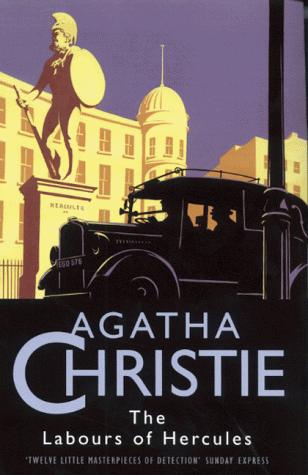
The Labours of Hercules... by Agatha Cristie


The Labours of Hercules is a short story collection written by Agatha Christie and first published in in the US by Dodd, Mead and Company in 1947 and in the UK by Collins Crime Club in September of the same year[3]. The US edition retailed at $2.50and the UK edition at eight shillings and sixpence (8/6).

It features Belgian detective Hercule Poirot, and gives an account of twelve cases with which he intends to close his career as a private detective. His regular sidekicks (his secretary, Miss Lemon, and valet, Georges) make cameo appearances, as does Chief Inspector Japp. The stories were all first published in periodicals between 1939 and 1947.

In the Foreword to the volume, Poirot declares that he will carefully choose the cases in order to conform to the mythological sequence of the Twelve Labours of Hercules. In some cases (such as The Nemean Lion) the connection is a highly tenuous one, while in others the choice of case is more or less forced upon Poirot by circumstances. By the end, The Capture of Cerberus has events that correspond with the twelfth labour with almost self-satirical convenience.

Thursday, 16 April 2009

The Hercules Text

Jack McDevitt’s first novel, published in 1986, The Hercules Text, tells the story of the discovery of the first confirmed extraterrestrial signals. Told from the point of view of Harry Carmichael, the bureaucrat administrator of the Goddard Space Center, the novel focuses in on the reactions a variety of scientists have to the message and their conflict with the United States government over the disposition of the information. McDevitt’s novel is set apart, however, by a strong message concerning the place this new knowledge has in the world.

Friday, 20 March 2009

A poem about Labours of Hercules

Could you be able to translate this poem? It's very easy!

hercules poem
hercules poem Antonio Piedra

Heracles, a Euripidean tragedy

Heracles or Hercules Furens (Greek: Ἡρακλής μαινόμενος / Hēraklēs Mainomenos) is a play by Euripides (c. 416 BC). While Heracles is in the underworld obtaining Cerberus for one of his labors, his father Amphitryon, wife Megara, and children are sentenced to death in Thebes, Greece by Lycus. Heracles arrives in time to save them, however the goddesses Iris and Madness (personified) cause him to kill his wife and children in a frenzy. It is the second of two surviving plays by Euripides where the family of Heracles are suppliants (the first being Heraclidae). It was first performed at the Great Dionysia festival and did not win any prize.