Heracleae urbis initia, ut Iustinus tradit, admirabilia fuerunt. Nam quia gravis pestilentia Boeotiae incolas vexabat nullumque inveniebatur remedium, contione advocata, Beotii statuerunt ut Delphos legati mitterentur oraculum consulturi de morbi causa. Interrogantibus oraculum morbi causam non patefecit sed imperavit ut fines suos, morbo corruptos, relinquerent, omnia sua secum auferrent, in Ponti regionem se transferrent et apud Pontum Euxinum coloniam Herculi sacram conderent. Oraculi responso cognito, Boeotii, paratis omnibus rebus suis, cum senibus, mulieribus puerisque domos agrosque reliquerunt et post longam peri****samque navigationem in Pontum pervenerunt, ubi ab Herculis nomine urbem Heracleam condiderunt.
Showing posts with label History. Show all posts
Showing posts with label History. Show all posts
Sunday, 3 May 2009

Stater coin from Lucanian Heraclia


You can admire this stater coin in the Archeological Museum of Naples. This silver stater coin is from the mint of Heraclia, dates in the Late Classical period, between 400 and 330 B.C., and presents Greek inscriptions. It shows the following imagines:
D/ ATHANAS; head of Athena with crested helmet, on which there is a depiction of Scylla throwing a rock with her left hand; R/ HERAKLEION; Hercules stands naked, with his lionskin on his head, fighting the lion Nemeus; in the background on the left is the god’s club and bow.
The mint of Heraclia is constantly identified by the types of Athena and Hercules, the hero of the city; the weight is that of the “nomos italiotikos" (= 7.76 grams) which, from the mid-fifth century B.C. onwards, characterised the issues of the Italiot cities. Silver coinage is recorded from the arrival of Pyrrus.
D/ ATHANAS; head of Athena with crested helmet, on which there is a depiction of Scylla throwing a rock with her left hand; R/ HERAKLEION; Hercules stands naked, with his lionskin on his head, fighting the lion Nemeus; in the background on the left is the god’s club and bow.
The mint of Heraclia is constantly identified by the types of Athena and Hercules, the hero of the city; the weight is that of the “nomos italiotikos" (= 7.76 grams) which, from the mid-fifth century B.C. onwards, characterised the issues of the Italiot cities. Silver coinage is recorded from the arrival of Pyrrus.
Heraclea (Policoro) - History

Heraclea ('Ηράκλεια in greek) was an ancient city of Magna Grecia, located near Policoro in Lucania, that takes its name from Herakles. It was founded by settlers from Tarentum and Thurii around 434 B.C. on a hill between the rivers Agri and Sinni on the ruins of the city of Siris, and in 374 BC was chosen as the capital of the Italiot League instead of Thurii that had fallen into the hands of the Lucanian. In 280 B.C. the city was the scene of the Battle of Heraclea between Rome and Tarentum. Always around 280 B.C. Heraclea became a confederate city of Rome. This is also the period of the tables of Heraclea, now preserved at the Museo Archeologico Nazionale di Napoli. They are bronze plates with texts in greek on the public and constitutional order of the city. On the back of these the Lex Iulia Municipalis is transcribed. At the end of the war between Rome and Tarentum, Heraclea fell under Roman control. In 212 B.C. the city was besieged and conquered by Hannibal. Later he became again a flourishing city and its inhabitants were described as Nobiles Homines by Cicero in Pro Archie, the defense of the poet Archie, a citizen of Heraclea. In 89 B.C. the inhabitants of Heraclea had Roman citizenship with Lex Plautia Papiria. During the Republican period, Heraclea was troubled by social unrest, with the passage of Spartacus in 72 B.C. The people then took refuge in the upper part of the city. In the imperial age its decline began. Today you can visit its ruins in the National Museum of Siritide in Policoro. You can see also the rests of the Temple of Athena and the Temple of Demeter. Remains of the ancient Acropolis were preserved. In the south and west part there are the necropolis.
Monday, 20 April 2009
The Dolar Sign: "$"
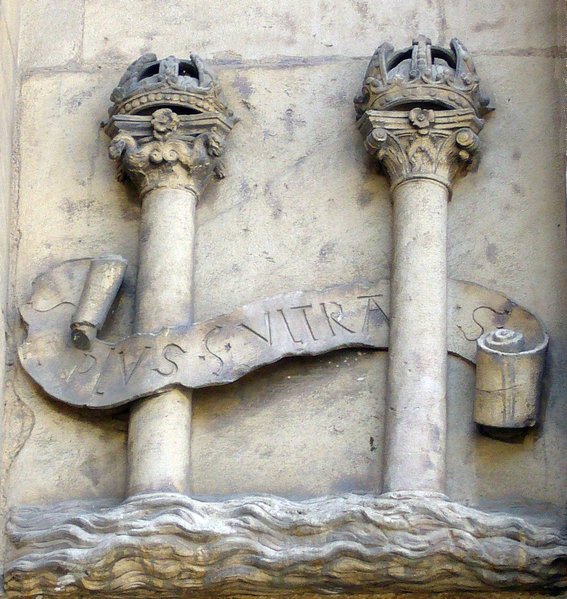 The most popular explanation is that the dollar sign derives from the Spanish coat of arms engraved on the Spanish colonial silver coins “Real de a Ocho” (”piece of eight”) or Spanish dollar under circulation in the Spanish colonies of America and Asia, as well as in the English Thirteen Colonies and later the U.S. and Canada.
The Spanish coat of arms has two columns (), which represent the Pillars of Hercules and an “S”-shaped ribbon around each, with the motto “Non Plus Ultra” originally, and later “Plus Ultra”.
Saturday, 11 April 2009
Hercules' Cave
 Hercules' Cave is underground domed spaces of Roman times placed in the city of Toledo (Spain), and located at San Ginés's alley.
According to the legend, Hercules built a bewitched palace near Toledo, constructed with jade and marble, and concealed in his interior the misfortunes that were threatening Spain. He put a padlock in the door and ordered that every new king should add one, since the threats would be fulfilled the day in which one of them was curious and was entering. According to the legend, Don Rodrigo was this king, and of the palace only there stays the current cave that would conceal wonderful treasures, among them the famous Table of Solomon.
Thursday, 26 March 2009
Maximian Herculeus
 Marcus Aurelius Valerius Maximianus Herculius (c. 250 – c. July 310), commonly referred to as Maximian, was Caesar (junior Roman Emperor) from July 285 and Augustus (senior Roman Emperor) from April 1, 286 to May 1, 305. He shared the latter title with his co-emperor and superior, Diocletian, whose political brain complemented Maximian's military brawn. Maximian established his residence at Trier but spent most of his time on campaign. In the late summer of 285, he suppressed rebels in Gaul known as the Bagaudae. From 285 to 288, he fought against Germanic tribes along the Rhine frontier. Together with Diocletian, he ran a scorched earth campaign deep into the territory of the Alamanni tribes in 288, temporarily relieving the Rhenish provinces from the threat of Germanic invasion.
Maximian Hercules defeated the mauri, to exterminate the pirates (earning the nickname of Hercules) and returned to Rome in 303 for victory with Diocletian.
Thursday, 12 March 2009
The pillars of Hercules
 The "Pillars of Hercules" (Latin, Columnae Herculis) was the phrase that was applied in Antiquity to the promontories that flank the entrance to the Strait of Gibraltar. The northern Pillar is the Rock of Gibraltar in the British overseas territory of Gibraltar. A corresponding North African peak not being predominant, the identity of the southern Pillar has been disputed through history, with the two most likely candidates being Monte Hacho in Ceuta and Jebel Musa in Morocco.
 The Pillars appear as supporters of the coat of arms of Spain, originating from the famous impresa of the Holy Roman Emperor, Charles V, King of Spain. The motto Plus Ultra (Latin for further beyond) indicates the desire to see the Pillars as an entrance to the rest of the world rather than as a gate to the Mediterranean Sea.
Subscribe to:
Posts (Atom)
