
Showing posts with label Arts. Show all posts
Showing posts with label Arts. Show all posts
Tuesday, 18 August 2009


Sunday, 10 May 2009
Labours of Hercules coins
Gibraltar has always had a strong connection with the myths of Hercules; one of his famous "Twelve Labors" describes how he erects two rock pillars, one in Europe, and one in Africa - hence the Rock of Gibraltar, now known as one of the "Pillars of Hercules". This mythological hero has been featured on Gibraltar's circulating 5 pound coinage since 1988 and was only introduced to the 2 pound coin with this series that was issued in 1997, 1998, 1999 and 2000. These coins all include the new effigy of Her Magesty Queen Elizabeth II, designed and sculpted by Ian Rank-Broadley F.R.B.S., F.S.N.A.D.
These 2 pound coins are all from Gibraltar, and are dated 1997, 1998 or 1999. These Uncirculated coins are made from "Bi-metal base metal", and appear two tone. The center section is the typical silver color of Copper-Nickel, and the outer ring is a gold tone.


These 2 pound coins are all from Gibraltar, and are dated 1997, 1998 or 1999. These Uncirculated coins are made from "Bi-metal base metal", and appear two tone. The center section is the typical silver color of Copper-Nickel, and the outer ring is a gold tone.


Monday, 4 May 2009


Wednesday, 29 April 2009
The Erymanthian boar ...by G.F. Susini
 Giovanni Francesco (Gianfrancesco) Susini (Florence c 1585 Florence – after 17 October 1653) was a Mannerist Florentine sculptor in bronze and marble, trained in the workshop of Giambologna.
He continued to work in Giambologna's style, and Susini's sculpture was already mistaken for that of his master by the end of the century. His uncle, Antonio Susini, was the principal bronze-caster of Giambologna, and the young Francesco received early training as a junior member of Giambologna's workshop.
Susini continued to operate the family bronze foundry. According to Baldinucci, Giovanni and Antonio Susini continued to use Giambologna's models after the elder master's death to cast finely finished bronze sculptures for discerning patrons.
You can admire his work Hercules Carrying the Erymanthian Boar, from model by Giambologna.
Tuesday, 21 April 2009
Hercules & Dürer
 Albrecht Dürer (May 21, 1471 – April 6, 1528)[1] was a German painter, printmaker and theorist from Nuremberg. His still-famous works include the Apocalypse woodcuts, Knight, Death, and the Devil (1513), Saint Jerome in his Study (1514) and Melencolia I (1514), which has been the subject of extensive analysis and interpretation. His watercolours mark him as one of the first European landscape artists, while his ambitious woodcuts revolutionized the potential of that medium. Dürer's introduction of classical motifs into Northern art, through his knowledge of Italian artists and German humanists, have secured his reputation as one of the most important figures of the Northern Renaissance. This is reinforced by his theoretical treatise which involve principles of mathematics, perspective and ideal proportions.
Dürer painted only two tables with pagan themes. This is one episode in the life of Hercules, and the other is the Death of Lucretia. The Hercules is exposed in the Germanisches Nationalmuseum in Nuremberg, the birthplace of the painter.
Sunday, 12 April 2009
The banquet of Hercules in Sant' Omero
 In February the "Sodalizio dei cultori di Ercole", an association formed around the most ancient church in Abruzzo, Santa Maria a Vico, Sant'Omero, holds the historical re-enactment of the pagan banquet of Hercules' followers, an event recorded in a Roman stone inside the church.
Sant'Omero is a town and comune in Teramo province in the Abruzzo region of eastern Italy.
Thursday, 9 April 2009
The Farnese Hercules
 The Farnese Hercules is an ancient sculpture, probably an enlarged copy made in the early third century AD by Glykon of an original of Lysippos or one of his circle, of the fourth century BC., made for the Baths of Caracalla in Rome (dedicated in 216 AD), where it was recovered in 1546.
The heroically-scaled Hercules is one of the most famous sculptures of Antiquity, and has fixed the image of the mythic hero in the European imagination. It quickly made its way into the collection of Cardinal Alessandro Farnese, grandson of Pope Paul III. Alessandro Farnese was well placed to form one of the greatest collections of classical sculpture that has been assembled since Antiquity.
Saturday, 28 March 2009
Francisco de Zurbarán & Hercules
 Francisco de Zurbarán (November 7, 1598 Fuente de Cantos, Extremadura– August 27, 1664, Madrid) was a Spanish painter. He is known primarily for his religious paintings depicting monks, nuns, and martyrs, and for his still-lifes. Zurbarán gained the nickname Spanish Caravaggio, owing to the forceful, realistic use of chiaroscuro in which he excelled.
In the palace of Buenretiro, Madrid are four large canvases representing the Labours of Hercules, an unusual instance of non-Christian subjects from the hand of Zurbarán.
Friday, 27 March 2009
Temple of Hercules Victor
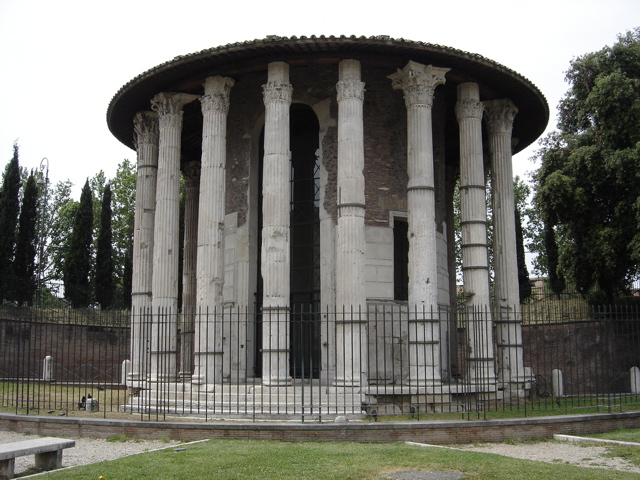
The Temple of Hercules Victor ('Hercules 'the Conqueror') or Hercules Olivarius is an ancient edifice located in the Forum Boarium in Rome. It is is a monopteros, a round temple of Greek 'peripteral' design (surrounded by colonnades on all sides). This layout caused it to be mistaken for a temple of Vesta.
Dating from the later second century BC, and perhaps erected by L. Mummius Achaicus, conqueror of the Achaeans and destroyer of Corinth, the temple is 14.8 m in diameter and consists of a circular cella within a concentric ring of 20 x 10.66 m tall Corinthian columns resting on a tuff foundation. These elements supported an architrave and roof which have disappeared.
The original wall of the cella, built of travertine and marble blocks, and nineteen of the originally twenty columns remain but the current tile roof was added later. Palladio suggested a dome, though this was apparently erroneous. The temple is the earliest surviving marble building in Rome.
Saturday, 14 March 2009
Temple of Heracles (Hercules) in Agrigento

Temple of Heracles (Hercules) (510 B.C.)One of the most beautiful temples of antiquity , it is now reduced in poor ruins. But even so, the building, still visible from far away, is imposing and rises in the Valley of the Temples just like the symbol of the power and strength of Herakles, the national hero of Sicily and, in particular, Agrigento.
The wide rectangular platform, mounted on four steps, measures m.73,992 in length and 27,788 in width, a triple square that occupies a surface of .2.056,89 square meters. It was m. 16,264 high.
Out of 38 columns (6 on the front and 15 on the long sides counting the corner ones twice), only 9 stand out today. They were put back up in 1922, thanks to the English captain Alexander Hardcastle.
(By Conci Mazzullo)
Friday, 6 March 2009
Tower of Hercules (La Coruña, Spain)
The Tower of Hercules is an ancient Roman lighthouse in La Coruña, Galicia, in north-western Spain. The structure is 55 metres (180 ft) tall and overlooks the North Atlantic coast of Spain. It is almost 1900 years old, was rehabilitated in 1791, is the oldest Roman lighthouse still used as a lighthouse.

Wednesday, 4 March 2009
Subscribe to:
Posts (Atom)


